Contextual Semantic Tokenizer (@msm-core/cst)
Zero-dependency bilingual morphological tokenizer separating root, template, clitics, and semantic roles while improving retrieval F1 by 32.8%.
Zero-Dependency TS10 Semantic Roles+32.8% F1 Retrieval
AI systems architect and researcher. Writing and building at the intersection of language model architecture, autonomous agents, and sovereign technology economics.
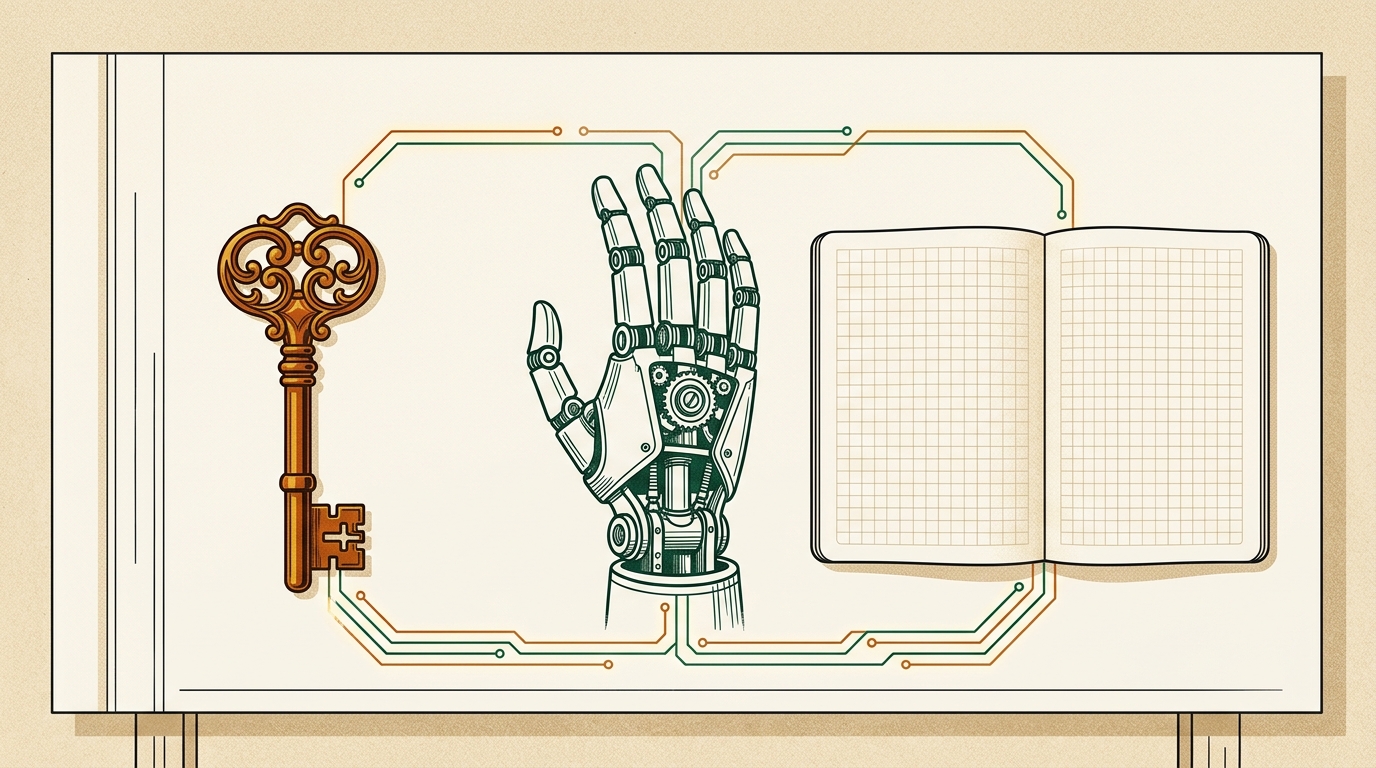
The model is a static file with no self-awareness, the agent is an ordinary program with no intelligence, and memory is a paper notebook. None of them is particularly dangerous on its own—so where does the danger come from when they meet?
Select an architectural tier to inspect its systems: from foundational engines and file formats, to the Mishkāt ecosystem and documentary studio, to the Kader enterprise platform.
Zero-dependency bilingual morphological tokenizer separating root, template, clitics, and semantic roles while improving retrieval F1 by 32.8%.
Zero-Dependency TS10 Semantic Roles+32.8% F1 Retrieval
Sub-millisecond cognitive perception gate combining 10,000D hypervectors with CST morphology to resolve 70% of enterprise intents on CPU.
MAP-HDC 10,000DOne-Shot Learning65% LLM Cost Cut
.uix unites Markdown prose, live SQLite state, and interactive UI inside one serverless file; .it turns plain prose into a SHA-256 sealed queryable database.
Markdown + SQLite + UISHA-256 Trust SealOffline-First
Unites MongoDB-style documents, FTS5 search, vector similarity, durable job queues, and distributed locks inside a single SQLite file.
Docs + FTS5 + VectorsDurable Queues & CronMIT Open Source
Replaces rigid folder hierarchies with automatic semantic indexing, allowing humans and agents to retrieve files by meaning and context.
Zero-Folder StorageHybrid FTS + VectorAgent-Native API
Buildroot Linux appliance architecture booting straight from kernel to fullscreen app, paired with Raqeem trajectory-based cursive Ruqʿah handwriting recognition.
Kernel → App BootA/B Atomic UpdatesCursive Ruqʿah HTR
Browser-native computed morphological and thematic knowledge graph of the Qur’an with zero generative distortion of canonical text.
Morphological GraphZero HallucinationClient-Side Engine
Computational DAG of 715,790 traditions across 425 sources with a 7-stage automated provenance verifier and common-link (madār) detector.
715,790 Hadiths577,024 Isnad Chains7-Stage Verifier
AI historical cinema studio pairing every episode with a source-verification ledger grading claims across 5 epistemic tiers cited to classical volumes and pages.
5 Epistemic GradesText-Driven AI StudioPrimary Source Ledger
Four zero-telemetry progressive web apps (Iqra’, Uktub, Iḥsib, Listen!) governed by automated curriculum decodability guards and HarfBuzz stroke skeletons.
read / write / calc / listenAutomated Curriculum Guard100% On-Device Privacy
Unified commercial enterprise platform deploying autonomous digital departments (Taqm) and collaborative workspaces (Warsha) on a single-file 5-tier memory engine.
Kader (Taqm + Warsha)5-Tier Nisus MemoryRBAC & Audit Ledger
Transforms receipts, voice notes, and chat messages into verified double-entry accounting records guarded by deterministic validation gates.
Voice & Receipt OCRDeterministic Balance GateInstant Audit Trail
Full-featured enterprise resource planning system running entirely inside a single portable monlite SQLite file with zero cloud lock-in.
Powered by monliteZero Cloud Lock-in1-File Backup
Single-file R-Tree reactive geo-database (Locus), sovereign fleet routing engine (Motus), and browser-native Arabic Sign Language & chessboard vision.
SQLite R-Tree Geo DBSovereign Fleet RoutingWebAssembly Edge AI
A five-chapter architectural narrative tracing the birth of the acting agent, the nature of files and interfaces, enterprise guardrails, the collapse of the software moat, and Arab technological sovereignty.
The model is a static file with no self-awareness, the agent is an ordinary program with no intelligence, and memory is a paper notebook. None of them is particularly dangerous on its own—so where does the danger come from when they meet?
A small secret hidden inside your everyday files—one you can verify in thirty seconds—explains how a machine built solely to predict words can draw vector logos, draft CAD blueprints, and edit films, toppling the barrier between ideas and execution.
From law and engineering firms to accounting departments and editing suites, AI is no longer a visitor inside a chat window—it is moving into the office itself. What do we gain from this arrival, what hidden hazards come with it, and how should we restructure our workplaces before it becomes a fait accompli?
For three decades, writing complex software was a fortress wall that protected tech giants and kept challengers out of the game. Today, AI is tearing that wall down—so what remains to protect incumbents, and who rises to the top next?
The core obstacle facing Arab technology is not a lack of capital or talent alone, but a structural failure to convert available resources into enduring software products and companies—a reality that will only change when we replace administrative guardianship and ceremonial incubators with open markets, procurement reform, and protected venture risk.
Technical monographs detailing how each engine, file format, epistemic graph, and studio pipeline was architected. Published papers are available in full; upcoming monographs display their opening preview.
Contextual Semantic Tokenization (CST) introduces a foundational shift inspired by Arabic root-and-pattern morphology to dramatically compress sequences and accelerate language model training worldwide.
For thirty years, computing has been split between static documents we own on our devices and live applications we rent on corporate servers. Today, with AI capable of writing software in seconds, it is time to tear down that wall: uniting prose, database, and interactive application inside a single portable file that travels over email and runs without a server.
How uniting document stores, vector search, job queues, five-tier agent memory, and semantic file indexing inside a single local file eliminates the cloud server sprawl
How 10,000-dimensional `MAP-HDC` hypervectors and `@msm-core` perceive intent in under a millisecond—sparing two-thirds of enterprise traffic from heavy LLM calls
Architectural lessons from building the Mishkāt Ecosystem (Qur’an, the 715,000-Hadith Isnad Graph, Early Islamic History, and Documented Historical Cinema): deterministic knowledge graphs as guardians of scholarly integrity
Inside the Mishkāt Early-Learning Family (`Iqra’` · `Uktub` · `Iḥsib` · `Listen!`): replacing slot-machine gamification and superficial localization with automated curriculum covenants
From a single-purpose Appliance OS (`osapps`) and cursive Arabic stroke recognition (`Raqeem`) to reactive geo-datastores (`Locus`): reinventing foundational systems from first principles
Many people have tried a “smart” customer service bot at a bank or telecom company only to find it acting like a rigid 1990s phone tree. I fell into that exact trap myself while building an AI bookkeeping agent—before discovering the architectural way out.
The prevailing trend today is to ask AI to “paint” an entire video from scratch out of statistical imagination. In a hands-on engineering experiment, my team took the opposite road: an AI director that writes every editorial decision as inspectable text, an execution agent that assembles real footage, and an uncompromising automated verifier—with a human signing off at the end.
We do not treat artificial intelligence as an opaque cloud API to be rented blindly, but as a structural shift that demands re-architecting the layers beneath and above it:
Replacing sprawling multi-server cloud dependencies with self-contained single-file architectures (monlite, .uix, .it) that run locally at disk speed.
Protecting canonical heritage and documentary media from probabilistic hallucination via deterministic graphs, automated verifiers, and 5-tier documentary proof grades.
Engineering algorithms around Arabic root-and-pattern morphology (CST) and authentic calligraphic stroke geometry rather than superficial localization.